Comparing Borrowers to Peers Outside of Your Portfolio
Clients with a license to use data from outside their Lending Cloud portfolio for peer comparisons choose the feature from the Peer Comparison Setup page when in a customer record.
Note System administrators manage the ability of users to access Ag Peer Comparison and the ability of users and administrators to use specific functionality in the feature. Information about setting up access and controlling functionality is located in the Ag Peer Comparison System Administration Settings section.
To select Moody's Ag data for peer comparisons
Take the following steps to incorporate state, regional, and national Moody's Ag data for peer comparisons and benchmarking:
Note To change the settings in all fields on the Peer Comparison Setup page back to the default settings for your institution, click the Reset to Defaults button in the upper-right corner of the page.
1. The Section field determines the number of years of information to use for data points in comparisons with all peer groups. The standard default setting is 5 Year. System administrators can change the default value using the Section field on the Peer Comparison Setup defaults page. Other options are 3 Year, 7 Year, 10 Year, and ALL. The ALL option uses all years of available information for data points in comparisons with all peer groups.
2. For each peer group that you want to include in the comparison, select the Enable check box.
3. From the Comparison Data drop-down list for each peer group in which you want to use outside data, select All Institutions.
Note The My Institution option on the Comparison Data drop-down list uses only peer data in your Lending Cloud portfolio for a comparison with the borrower.
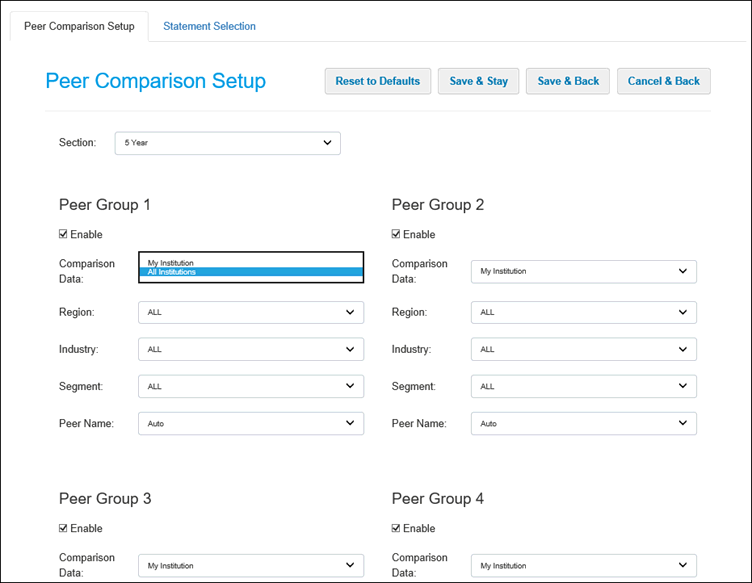
Steps 4-7 describe functionality related to the Region, Industry, and Segment categories, which are used to determine the data that will be calculated for peer comparisons.
Note If your institution previously saved Region, Industry, or Segment settings on specific customer records, some of those settings might not match new default values established by your institution. When you select Ag Peer Comparison in the customer record, if customer-level values differ from the institution-level default values, you will receive a warning message describing the conflicting settings. You will be unable to save changes and exit until you update the customer-level settings to align with the institution-level default settings. See To set institution-level defaults for categories associated with calculations in the Ag Peer Comparison System Administration Settings section for information about default settings for the Region, Industry, and Segment categories.
4. Select the appropriate option from the Region drop-down list. Up to four options are available.
-
-
ALL - This option uses the USDA region of the borrower for the peer comparison.
-
USDA - This option enables you to use the USDA region of the borrower, or another USDA region for the peer comparison.
-
Country - This option enables you to use the country of the borrower or another country for the peer comparison.
-
State - This option enables you to use the state of the borrower or another state for the peer comparison.
-
Note Whether the USDA, State, or Country option is available is based on your institution's default settings. User Defined Region is not available for peer comparisons outside of your institution's portfolio.
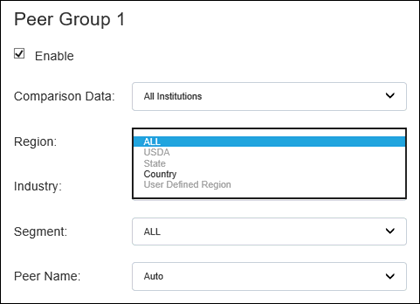
If you select USDA, State, or Country as the region, the Sub Region field appears under the Region field. Your selection in the Region field determines the options that appear on the Sub Region drop-down list.
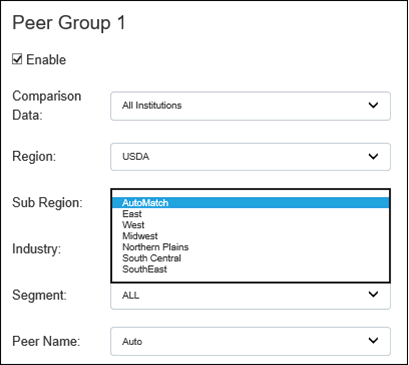
5. From the Sub Region drop-down list, select the appropriate option.
If you select USDA as the region, also select the appropriate option from the following on the Sub Region drop-down list:
-
-
AutoMatch - This option uses the USDA region of the borrower for the peer comparison.
-
East
-
West
-
Midwest
-
Northern Plains
-
South Central
-
SouthEast
-
The last six options correspond with the regions defined on the USDA Map of Regions. If you select one of the USDA regions, the system uses data from that region for the peer comparison, regardless of the borrower's USDA region.
If you select Country as the region, also select the appropriate option from the following on the Sub Region drop-down list:
-
-
AutoMatch - This option uses data from the country of the borrower for the peer comparison.
-
CAN - This option uses Canadian data for the peer comparison, regardless of the borrower's country.
-
USA - This option uses United States data for the peer comparison, regardless of the borrower's country.
-
If you select State as the region, also select the appropriate option from the following on the Sub Region drop-down list:
-
-
AutoMatch - This option uses data from the state of the borrower for the peer comparison.
-
Two-digit abbreviations for each of the 50 United States, the District of Columbia, and Puerto Rico
This option uses data from the state or territory that you select, regardless of the borrower's state or territory.
-
6. Select the appropriate option from the Industry drop-down list.
-
-
ALL - No filter
-
NAICS2 - Use the first two digits of the NAICS code.
If you select this option, the Industry Sub Group field appears under the Industry field. If you select AutoMatch from the Industry Sub Group drop-down list, the system uses the first two digits of the borrower's NAICS code. Otherwise, select another option. -
Schedule Product - Use a product group.
If you select this option, the Industry Sub Group field appears under the Industry field. If you select AutoMatch from the Industry Sub Group drop-down list, the system uses the borrower's primary gross revenue stream. Otherwise, select one of the other options - Ag, Crop, Livestock, LivestockProduct, or Mixed.
-
-
-
NAICS4 - Use the first four digits of the NAICS code.
If you select this option, the Industry Sub Group field appears under the Industry field. If you select AutoMatch from the Industry Sub Group drop-down list, the system uses the first four digits of the borrower's NAICS code. Otherwise, select another option. -
NAICS6 - Use the first six digits of the NAICS code.
If you select this option, the Industry Sub Group field appears under the Industry field. If you select AutoMatch from the Industry Sub Group drop-down list, the system uses the first six digits of the borrower's NAICS code. Otherwise, select another option.
-
Note Whether the NAICS2, Schedule Product, NAICS4, or NAICS6 option is available is based on your institution' default settings.
7. Select the appropriate option from the Segment drop-down list.
-
-
ALL - No filter
-
Revenue - Use gross revenue.
Note Whether the Revenue option is available is based on your institution' default settings.
-
If you select Revenue, the Segment Sub Group field appears under the Segment field. Select one of the following options from the Segment Sub Group drop-down list:
-
-
-
AutoMatch - The system will use the borrower's revenue from the latest financials to determine which revenue band is selected.
For example, if the borrower had revenue of $2.2 million last year, $1.8 million two years ago, and $1.5 million three years ago, the system will use the $2MM-<$5MM band for comparison. A list of revenue bands appears below. Since a comparison generally covers multiple years based on your setting in the Section field, peers can fall into different revenue bands over that period. When you select AutoMatch and run a comparison, the system will return data for peers that fall into the borrower's most recent revenue band ($2MM-<$5MM) in any of those years.
Note If the revenue band of returned peers does not consistently fall into the borrower's revenue band over the designated period, you might find it more helpful to select a specific revenue band for a new comparison to obtain more consistent results. Also, if you select AutoMatch and find that the revenue band of returned peers does not consistently fall into the borrower's revenue band over the designated period, you can select ALL from the Segment drop-down list. Running a comparison with no revenue filter is more likely to return a greater number of peers that consistently fall into the borrower's revenue band. After reviewing the returned data, if more specific results are desired, use the Revenue option and select the appropriate revenue band for a new comparison. -
<$100K
-
$100K-<$500K
-
$500K-<$1MM
-
$1MM-<$2MM
-
$2MM-<$5MM
-
$5MM-<$10MM
-
>=$10MM
-
Other - Use peers, regardless of revenue range.
-
-
8. Use the Peer Name field to create the name of the peer group. Select one of the following options.
-
-
Auto
The system generates the peer group name based on product, region, and revenue criteria that you selected in preceding fields. -
Simple
The system uses standard naming for the peer group, for example, "Peer1". -
Manual
This option enables you to apply a preferred description/short name to the peer group. When you select Manual, a field appears under the Peer Name field. Enter the preferred description/name in the field.
-
9. Click the Save & Stay button or the Save & Back button. If you click the Save & Back button, the system returns you to the Peer Comparison page.